
Having been an Engineer in Nigeria for more than a decade, I would say that one of the issues I have seen is, Plumbers deciding to embed their waste pipes inside the slabs to be casted. Most times, I approach the Engineers and request why did they not consider other alternatives. Their response has varied each time. Some will tell you that running your waste pipes on the surface means that you will have a higher screed level for the floor while tiling. That this will lead to higher costs in purchasing additional sharp sands which also leads to additional cement being required.
Sometimes, the response we get is, this is the normal practice and it is perfectly safe. Only a few Plumbers or Engineers act puzzled or are inquisitive to request if there is a better way to route your plumbing waste pipes. To the inquisitive ones, I go ahead to explain to them the risk involved in embedding your plumbing waste pipes inside the building slab. I explain to them how Plumbing codes forbid this act. The main reason this is forbidden is for the fact that the areas where you embed those 2in or 4in waste pipes will be weak structurally.
Most slabs used in buildings are designed to not exceed 152.4mm (6in). This means that when you embed that 2in pipe inside the slab, you will be reducing the volume of concrete in that portion of the slab. Plumbers often refer to PVC pipes with outer diameters of 48.3mm as 2in PVC pipes where as in reality they are 1-1/2in PVC pipes. So with a 2in PVC pipe in place, that portion of the concrete in the slab will be 104.1mm. This is relatively weak when compared to the designed 6in (152.4mm) thickness.
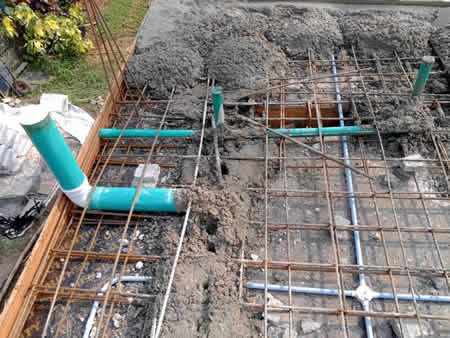
Figure 1.1: Showing a 4in soil waste pipe installed in 6in slab
This made even worse when a 4in waste pipe is intended to be installed. A 4in waste pipe has an outer diameter of 114mm. Thus when installed in a 6in (152.4mm) slab, you will have a slab thickness of 38.4mm left. This means that you will have a thickness of less than an inch around the 4in pipe. It's for this reason that portions with 4in pipes are unconsciously overfilled above 6in.
"Most waste pipes referred to as 2in in Nigeria are actually 1-1/2in pipes. Their outer diameters are actually 48.3mm rather than 60.3mm."
This makes these areas fragile and weak structurally. This is one of the reasons I don't run my waste pipes inside my slabs especially the 4in waste pipe.
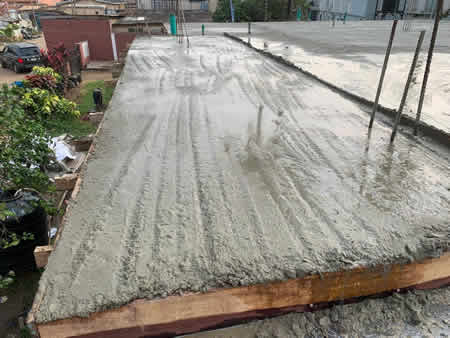
Figure 1.2: Showing how a protruding 4in waste pipe affected the thickness of slab casted
Another reason, we do not embed waste pipes in slabs, is that waste pipes need to be sloped at 1% or 2% in order to allow for easy movement of the waste liquid, slurry or solid. A 4in waste pipe must have a slope that does not allow the liquid waste to flow ahead of the solid waste. If you have visited a slab just about to be casted with reinforcement done, you will realize that when you embed the waste pipes in between reinforcements and position them perfectly, you will realize that it is quite difficult to keep the slopes intact. It's either the slope gets enormous or the there is no slope or the slope gets reversed later on during casting when pressure on the reinforcements might alter the slopes. Some people might say you can make use of binding wires to keep your slope intact. However, this is difficult to setup and it is also not fail proof. If you study the picture above, you will realize that both pipes had feint slopes though difficult to see. Here the Plumber did a good job trying to keep a slope, but I have witnessed numerous projects where the slope didn't exist or it got reversed from continual movements close to it. The possibility of this error occurring discourages me from this practice. Also, if this occurs one might not know as the pipes will remain hidden and solid waste will remain static over a long period of time.
The third reason, I discourage in-slab plumbing piping is the possibility of the pipes getting damaged. Besides running waste pipes inside slabs, many plumbers also run supply pipes inside slabs. Supply pipes carry distribute liquid sometimes under gravity and sometimes under pressure. So if in the future a booster pump was connected to the supply pipes running inside the slabs and this pump delivered pressures exceeding the limits that can be withheld by the supply pipes, then you will have leakages at the supply pipe's joints or connections with other fittings. These leakages will happen inside the slab and might take a while to be noticed. The reason for this delay is because modern buildings now have false ceilings called POP ceilings installed below all floors slabs and tiles installed above all floor slabs. Thus it is when droplets of water are noticed on the POP ceilings that leakages can be picked out or envisaged. More so, you cannot repair these leakages as they are inside the slabs. The only solution will be to run entirely new supply lines.
The fourth reason we do not support in-slab plumbing is the inability of the Plumber to use the right fittings because of the limited space he has for installation. Also, its almost impossible to position your waste and supply pipes uprights at the desired design position. Sometimes the plumber might be accurate and sometimes he will just be close to the right position. When he does not get the position of the floor drain accurate, he will resort to above slab waste piping. In addition, looking at the pictures below, you will notice that for some connections it would have been best for the Plumber to use Y-tees rather than tees. And in some places, he could have used 2Nos of 45 degrees elbows/bends rather than 90 degrees bends.
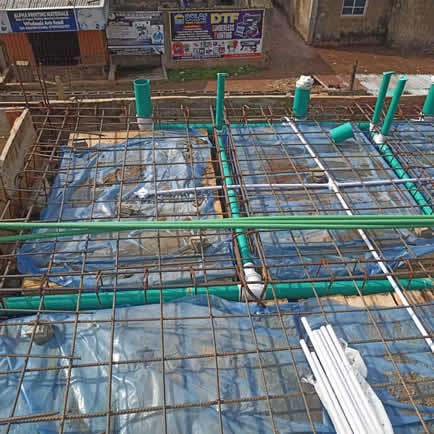
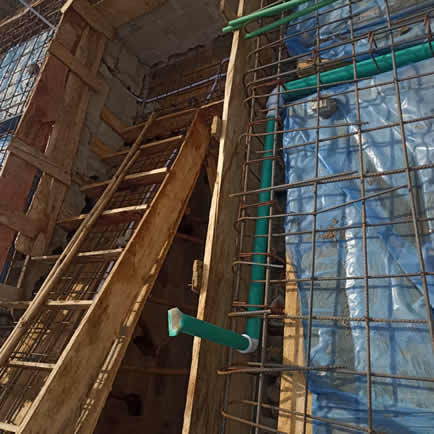
You will also notice that these waste pipes consume tremendous amount of spaces inside the beams and slabs. These portions occupied by pipes will be hollow and reduce the structural strength of the slab or beam in those particular locations.
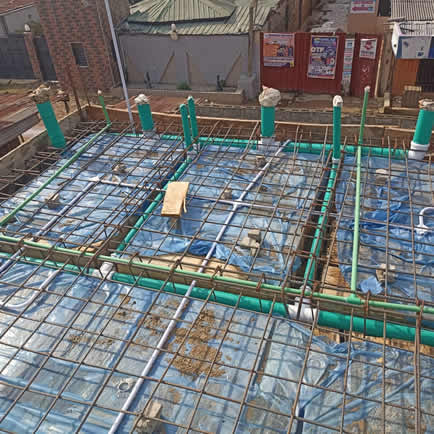
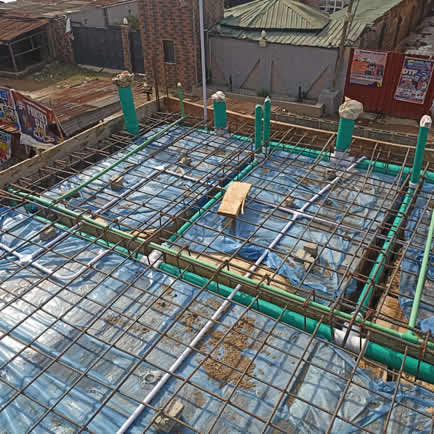
When in-slab plumbing work is being done, I am always of great admiration as I acknowledge that it requires great work and skill to fit in pipes inside iron reinforcements. However, I feel it's totally needless when they are done. I feel the Plumber would have been happier if he knew there was another way to achieve the same or better results.
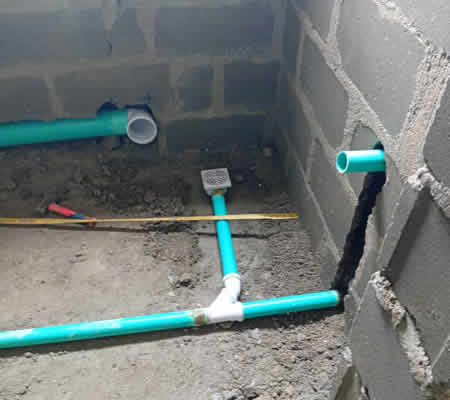
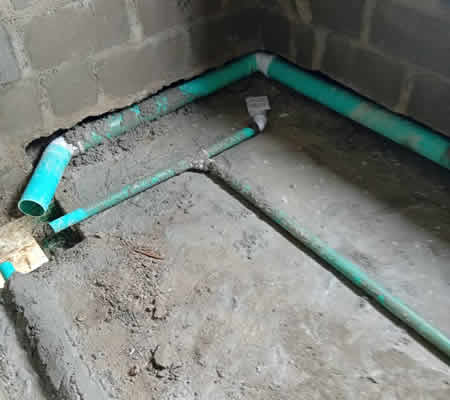
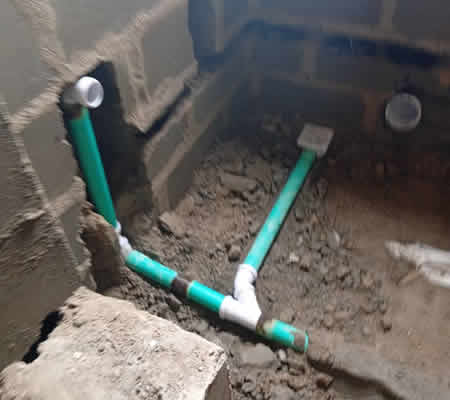
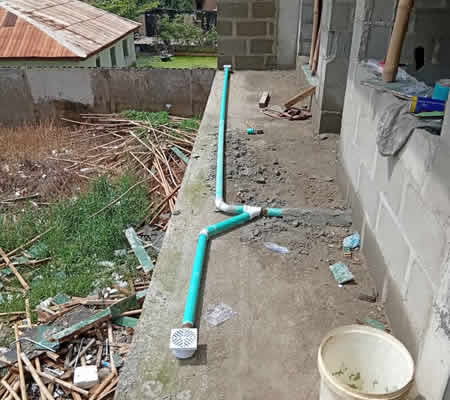
At Teknitech Engineering Ltd, we do not run our waste or supply pipes inside slabs. We run them through ducts and if there are no ducts, we run them only above the slabs. Never, inside the slabs.
"Teknitech Engineering Ltd is a top Plumbing design and installation company in Nigeria."