
"AC refrigerant piping should be carefully insulated separately always"
"Everywhere, everyone installs their AC refrigerant pipes with one outer insulation kit." This was the response I got when I challenged a Contractor as to why their AC refrigerant pipes were not independently insulated. Well, the Contractor to a large extent may be right. Almost everyone in Nigeria runs their AC refrigerant pipes with only one outer insulation. The fact stated above does not make this practice the right one.
Refrigerant pipes are simply copper pipes with high conductivity that connect both the indoor unit with the outdoor units in a Split AC setup. This can be re-stated as, AC refrigerant pipes in an AC setup are two (2) copper pipes connecting the indoor unit ( which contains the expansion valve + evaporator coil) with the Outdoor unit (which contains the compressor + condenser coil).
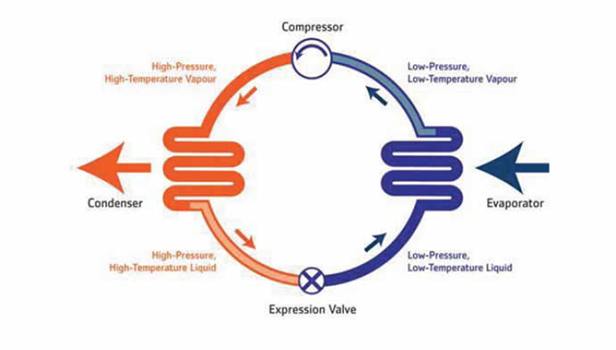
Looking at the refrigerant cycle diagram above, one of the refrigerant pipes will carry the refrigerant in gaseous state at low pressure and low temperature. The second refrigerant pipe will carry the refrigerant in liquid phase at a high pressure and high temperature. This means that one pipe will be cold to touch and carry gaseous refrigerant. This pipe will be the larger pipe of the two refrigerant pipes. The second one will be warm/hot to touch and carry liquid refrigerant. This pipe will be the smaller pipe of the two refrigerant pipes.
When you decide to insulate both refrigerant pipes as one, you will directly be ensuring that both refrigerant pipes have thermal contact with one another. Thus the warm liquid refrigerant line will pass heat to the cold gaseous refrigerant line. The warm liquid refrigerant line will continually loose heat and arrive the Expansion valve cooler than expected. In some instances, gases will already be formed before the refrigerant reaches the evaporator. This means that the evaporator will have less mass of cool liquid refrigerant that it can blow air (hot air that becomes cool air) across. The evaporator coils will be less cool than designed, as a portion of the refrigerant that should be in cold, liquid phase are already in gaseous state. Another effect of these practice, is that the resulting gas from the evaporator is in a sub-cooled state (temperature below that designed for efficient operation of the system).
Also, in turn the larger refrigerant pipe carrying the cold, low pressure gaseous refrigerant will have acquired heat from the other refrigerant pipe. This means that the gaseous refrigerant will arrive at the compressor at a higher temperature and pressure than that designed. This warmer refrigerant gas being less dense will take longer to be compressed and consume more electricity or power in the long run.
Another effect of this setup is that, the cold gaseous refrigerant pipe may drop below dew point in very humid environments and lead to condensation along the pipes which leads to water droplets on ceilings and walls and thus the formation of molds.
Overall, the cooling capacity and efficiency of your air conditioning unit will drop while your compressor will work harder and longer hours until the desired room temperature is reached which eill lead to higher electricity costs and a shortened compressor lifespan.
Our advice:
- If you were to look at the two refrigerant pipes attached to the indoor unit, you will realize that they were independently insulated by the manufacturer. this means that the manufacturer intends for you to insulate each pipe independently.
- If you were to purchase the refrigerant pipe kit which comes pre-insulated, you will realize that both refrigerant pipes were also separately insulated.
This means that when setting up AC conduits and you need to run your refrigerant pipes over long distances (< 15m), you should prepare to always insulate the refrigerant pipes independently using the correct insulation sleeve size.
Teknitech Engineering Ltd - is a leading HVAC design and installation company in Nigeria.